
title icon
Karytron

HT PANEL TESTING

dustrial-inner-thumb-min

HT Panel Testing Services

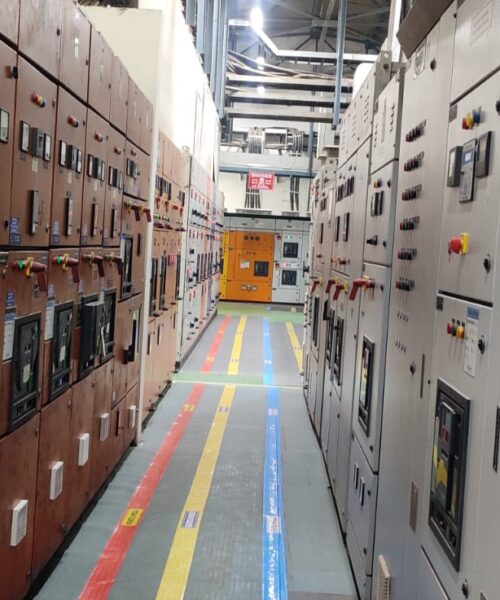
High Tension (HT) panels are like the central nervous system for high-voltage power distribution systems. Usually running at a voltage of 3.3kV, 11kV, or even 33kV, these systems supply vast amounts of electricity to power industrial installations, huge facilities, and public services. However, the panels endure damage over time from things like high thermal loads, moisture, insulation breakdown, mechanical strain, and electrical transients, i.e., voltage surges.

It’s a holistic and systematic diagnostic and performance check performed on high-voltage equipment like switchgear assemblies, circuit breakers, protective relays, instrument transformers and busbars. If these diagnostic checks are conducted periodically by reliable HT Panel Testing Services, the HT Panel will be safe to operate, reliable for circuit tripping during electrical faults and it will hold strong insulation to avert severe damage to the equipment or any arc flash.

In our present facility management practices, this diagnostic is no longer an option, but a necessity to achieve operational consistency and enhance the safety of humans.

Businesses where uninterrupted power is crucial should get its installations regularly checked through thorough High Tension Panel Testing adhering to Indian Standards (IS) as well as IEC (International Electrotechnical Commission) standards and following Central Electricity Authority (CEA) safety guidelines. At Karytron, a leading HT Panel Testing Company, we offer Certified High Precision HT Panel Testing in India to businesses. With years of experience, calibrated testing tools and rigorous implementation of standard testing procedures, Karytron offers solutions that protect high voltage equipment, provide necessary regulatory compliance and save you the cost of unplanned business disruption.

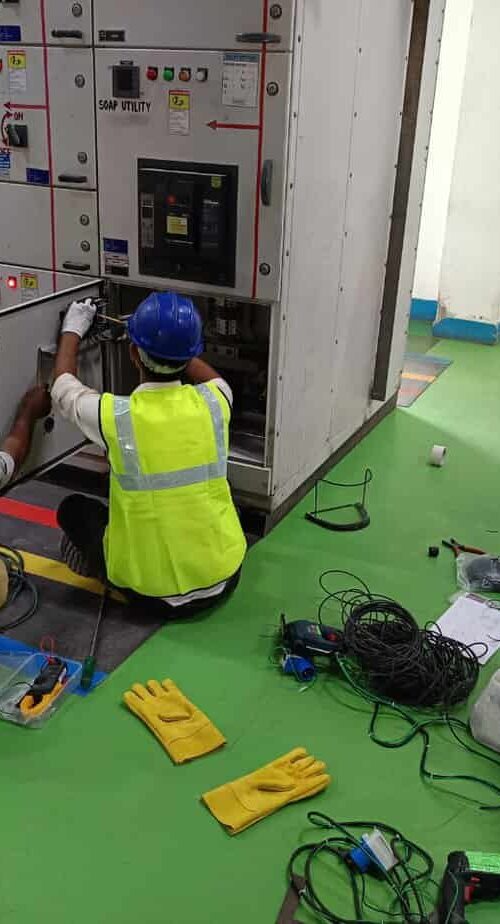
What is HT Panel Testing?

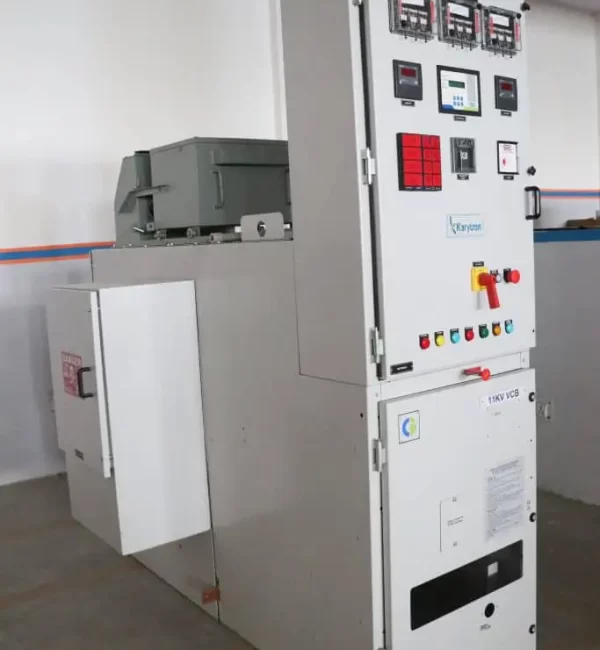
HT Panel Testing means that we will do a series of tests that involves physical visual examination, tests conducted mechanically and some with electrical diagnose tests done on high tension switchgears assemblies like vacuum circuit breaker (VCBs) for evaluating structural integrity and testing insulation resistance, contacts, and the functioning of fault protection.

Purpose

The intention and focus of HT Electrical Panel Testing is to test that all the electrical, mechanical and electronic components are functioning as intended and are safe as per design. It means we test that the system is capable of continuously carrying current under normal load conditions, safely interrupting fault current, and isolating the faulty segment of a network.

Why We Need Regular HT Panel Testing?

HV electrical power distribution systems are always stressed, both thermally during each electrical cycle and physically under various environmental conditions. As time goes by:

* The original insulation will begin to degrade from heat, humidity and tracking.
* Lubricants dry up in the switchgear, making it heavy and sluggish, dust accumulations also occur within this same mechanism.
* Protective relays that switch the breaker can start drifting away from their required trip characteristics, causing either slow tripping or not tripping at all when a fault occurs.
* The bolted connections between phases and busbarjoints can relax over a period of time due to vibrational stresses, which will result in high resistive joints that start to overheat.

A systematic inspection plan during HT Panel Testing helps engineers to pinpoint and resolve small issues before a total failure occurs.

Consequences Of Not Testing HT Panels?

If you neglect regular HT Panel Maintenance and diagnostic tests, you risk:

* Unplanned Power Outage: Insulation breakdown, which can lead to a line-to-line and/or line to ground short circuit, resulting in the upstream feeder tripping out and taking the entire plant to a standstill.
* Arc Flash and Explosion Hazards: In case the switchgear is faulty, or insulations are damaged, the power can cause arc flashes which are a serious hazard that are capable of destroying rooms, sub-stations, and personnel.
* Loss of Protection: When Protective Relays can’t detect a fault, or in case the VCB mechanism becomes jammed, current can travel further into your power system, damaging any high-voltage transformers that may be present.
* Regulatory Non-Compliance: Utility inspectors or any statutory bodies are capable of issuing you notice or disconnecting the supply line altogether if no updated certificates from HT Testing are available.

HT Panel Testing Services We Offer

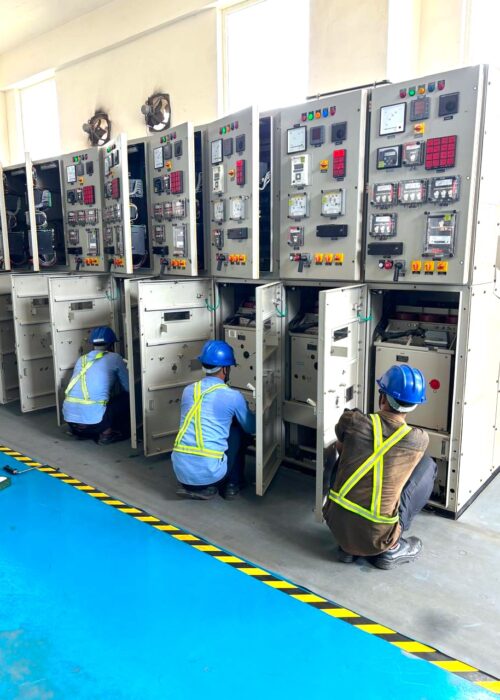
At Karytron, we’re your one-stop shop for complete HT panel testing and diagnostics for HT switchgear and Vacuum Circuit Breakers (VCBs). Here’s a look at what we do:

1. Visual & Environmental Inspections

* Multi-Parameter Visual Checks: We do a detailed HT panel inspection that can cover up to 8-9 different visual and structural aspects of your breakers and panel frameworks.
* Hot Spot, Moisture, & Corrosion Evidence Audits: We zero in on about 8-9 parameters looking for any signs of heat stress (thermal discoloration), tracking, moisture intrusion, and any rust forming on metal structures like busbars or enclosures.
* Gaskets & Openings Inspection: We make sure all the seals and openings are up to par so your IP rating is maintained, keeping critters, dust, and moisture out.

2. Mechanical Servicing & Alignment

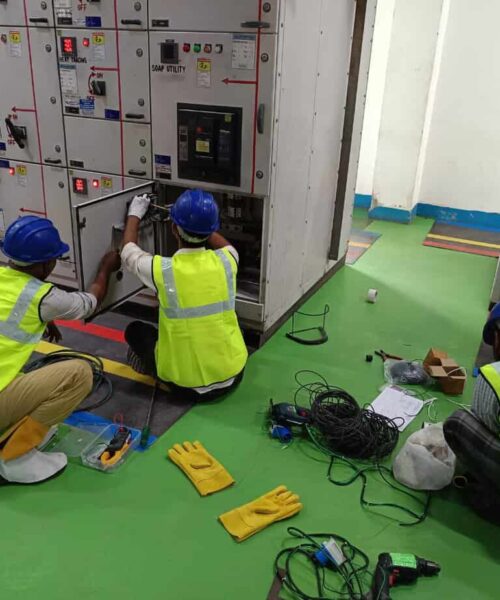
* Busbar & Termination Maintenance: This is part of our thorough HT Panel Maintenance process. We’ll clean, torque-tighten, and generally service your busbars, insulators, CT/PT connections, end terminations for power cables, and control and power circuit connections.
* Lubrication & Alignment: To ensure your mechanical systems work smoothly, we’ll apply the right lubricants to your racking mechanisms, main contacts, auxiliary contacts, and operating linkages.
* Epoxy Re-conditioning & Insulating: For your 33kV VCB panels, CTs, PTs, and any other affected areas, we’ll recondition, service, and apply liquid HT insulation or epoxy gel to restore that vital dielectric strength.

3. Electrical & Insulation Diagnostics

* Insulation Resistance (IR) Testing: We do these IR tests before and after our DC High Potential (Hi-Pot) tests on your VCBs, CTs, PTs, busbars, and power cables to check their insulation health.
* Polarization Index (PI) Test: This test, usually done on power cables, gives us a good sense of how the insulation resistance performs over a longer period.
* DC Hi-Pot (High Potential) Test: This is a high voltage stress test we use to ensure the insulation in your circuit breakers, busbars, CT/PTs, and cables can withstand overvoltage conditions.

4. Breaker & Protection System Testing

* Tripping & Closing Timing Test: Using precision analyzers, we measure the opening, closing, and contact bounce times for your VCBs.
* Contact Resistance Test: We take a look at the contact resistance (measured in micro-ohms) across your main contacts to check for signs of wear, erosion, or surface oxidation.
* Manual & Electrical Operation Tests: We confirm that your breaker closes and trips correctly using both local push buttons and remote electrical signals, including shunt trip coils and undervoltage releases.
* Secondary Injection Relay Testing: We’ll inject electrical signals directly into your auxiliary and numerical protection relays to verify that the settings for overcurrent, earth fault, and differential protection are functioning as expected.
* Primary Injection Testing: We inject heavy primary currents through the Current Transformers (CTs) to verify the CT ratio, polarity, tripping circuits, and metering core loops for your primary and backup protection systems.
* Auxiliary System Checks: Finally, we check the operational aspects of all your control wiring, signaling indicators, meters, battery chargers, and DC power packs.

Have a question or ready to schedule a test? Get in touch with us today!

HT Panel Testing Process

Karytron’s step by step field execution procedure ensures safety, accuracy and minimum turnaround time. The process comprises of following steps: [Site Visit] [Safety by Isolation] [Visual & Dimensional Inspection] [Electrical Testing] to Recommendations] [Report Submission] [Result Analysis]

Site Inspection & Planning: Coordinating in advance with customer engineers on site conditions, busbar panel single-line diagrams(SLDs), and physical access. Safety Isolation & Earthing: Strictly following Lockout/Tagout (LOTO) procedures, isolating incoming/outgoing HT feeds, verifying dead, and applying temporary earth leads before contact.

Visual & Mechanical Inspection: Systematic identification of moisture, dust, smut, hot spots, rust, degradation of seal materials, and loose mechanical parts. Cleaning and torque tightening of busbar joints.

Electrical Testing: Installing temporary fixtures and probes to measure phase insolation gaps, then conduction of low-voltage IR, Hi-pot, contact resistance, relay injection, and timing tests. Relay & Protection Testing: Injecting relay circuit test currents and voltages to trigger protective relays and ensure positive trip signals reach the circuit breaker.

Data Comparison: Evaluating diagnostic test results by comparing readings with OEM standards, previous tests, and national and world standards. Documentation of test results: Preparing easy-to-understand test certificates that include raw data, test conditions, equipment serial numbers, and pass/fail results.

Suggestions & Future Action: Advising on required component replacements, re-coating of insulation, and subsequent testing and inspection schedules.

title icon

Why HT Panel Testing is Important

Prevention: “The cost of preventive maintenance and regular Electrical testing is very low compared to cost of failure in a single instance in case of a major Switchgear explosion or unscheduled power shutdown”

Pre-empts electrical failures: Allows the early detection of weakness in insulating members, heating of bus bars, and drifting of relays in order to check for shorts and unpredicted explosive failures.

Increases reliability: Provides the ability to make perfectly functioning and calibrated VCB to operate on actual electrical failure.

Maintains Worker safety: Evades a electrical failures such as arcing, flashovers and tracking and thus saving personnel’s lives.

Reduces unplanned outages: avoids unplanned shut downs which are costly, especially in a continuous production process.

Finds latent or concealed faults: Primary injection tests, PI tests, micro-ohm contract resistance test allow us to identify not so obvious faults such as crackling of insulating material, surface condition of contacts.

Keeps statutory requirements: the tests are required to maintain the health of the high tension electrical systems as demanded by the CEA and the state electrical inspectorate.

Extended equipment life: Regular over-hauling, maintenance such as over-hauling of VCB, insulation washing and coating, and torque checks of all electrical equipment and Bus Bars can help extend their lifespan, for a fraction of the cost.

title icon

Standards We Follow

Audits by Karytron

As part of our HT Switchgear Testing procedures, Karytron meticulously follow all the national and international codes which are as follows:
·IS 8623 / IS 13947 / IS 2147: These are the Indian standards related to low-voltage/high-voltage switchgear assemblies, enclosures, and degree of protection (IP rating).
·IS 3427 / IS 12729: These are the Indian standards dealing with the metal-enclosed switchgear and controlgear for voltages exceeding 1 kV up to 52 kV.
·IS 2026 / IS 2705 / IS 3156: This are the Indian Standards on Current transformers (CTs) and Potential transformers (PTs).
·IEC 62271-200 & IEC 62271-100: These are the international standards for AC metal-enclosed switchgear, controlgear, and high-voltage alternating-current circuit breakers.
·CEA Regulations (Measures Relating to Safety and Electric Supply): These are the Indian codes related to hi-voltage electrical installations and inspection logs.
·IEEE & NETA Guidelines: These are some international maintenance testing standards accepted globally.

title icon

Industries We Serve

The availability of reliable, high-voltage distribution is paramount across various industries and sectors. Karytron provides expert, certified HT Switchgear Testing and commissioning services for:
* Manufacturing & Heavy Industries, including Steel Plants, Automotive facilities, Textile mills, and Chemical processing units.
* Commercial Complexes & IT Parks that feature high-rise corporate office spaces and commercial hubs that demand un-interrupted power for round-the-clock operations (24/7).
* Data Centers, where even a momentary (millisecond) power interruption might result in substantial data loss and service outages.
* Hospitals & Healthcare Facilities, which are essential facilities wherein life-support systems, devices and machines are dependent upon a continuous and uninterrupted supply of power, both from the utility grid and the back-up system.
* Hotels & the Hospitality Industry, such as premium resorts and hotel chains that are interested in avoiding local transformer or switchgear failures.
* Power Plants & Renewable Energy installations, which may be solar parks, wind farms or captive power plants.
* Warehouses & Logistics Hubs – Automated distribution centers that have their operations, including material handling systems, entirely dependent on the continuous supply of electrical power.
* Educational Institutions & University Campuses, such as the large integrated campus power substations.
* Infrastructure & Public Sector Projects, including Airports, MTR metro rail networks, Water Treatment plants and Railway substations.


fault levle calculations

Why Choose Karytron for HT Panel Testing?

Electrical high voltage power stability and safety within any facility rely heavily on an expert testing partner. Karytron is a trusted HT Panel Testing Company where companies from all across India look for us because of the following reasons:

Frequently Asked Questions

HT Panel Testing is a comprehensive procedure involving visual inspections, mechanical servicing, and electrical diagnostic tests (such as IR, Hi-Pot, primary/secondary injection, and contact resistance) performed on High Tension switchgear panels to ensure safe and reliable high-voltage power distribution.

Performing periodic High Tension Panel Testing confirms that circuit breakers trip during short circuits or overloads, insulation systems remain intact under electrical stress, and bolted connections have not developed high-resistance hotspots. It helps avoid catastrophic failures, facility fires, and costly downtime.

It is recommended to carry out complete diagnostic HT Electrical Panel Testing at least once every 12 months. High-duty cycle or harsh industrial environments may require bi-annual visual and thermal checks.

As part of our specialized HT Panel Testing Services, standard tests include Insulation Resistance (IR) checks, DC Hi-Pot testing, Primary and Secondary Injection testing for relays and CTs, Breaker Contact Resistance testing, Tripping/Closing timing tests, and Polarization Index (PI) tests.

High-voltage diagnostic testing follows IS 3427 / IS 12729, IS 8623, IEC 62271-200, CEA Safety Regulations, and standard Electrical Inspectorate guidelines.

A standard single-incomer, multi-outcomer 11 kV or 33 kV, panel shutdown testing process typically takes between 4 to 8 hours, depending on the number of circuit breaker spouts, CTs/PTs, and relays to be tested.

Yes. Routine testing identifies minor defects that can be resolved on-site through servicing, busbar tightening, contact replacement, or applying epoxy re-conditioning coatings without replacing the panel.

Yes. Karytron provides detailed, structured test reports signed by qualified testing engineers, suitable for statutory safety compliance, insurance verification, and internal audit records.

Any facility operating high-voltage transformer sub-stations requires professional High Voltage Panel Testing, including manufacturing plants, data centers, hospitals, power generation plants, commercial malls, and infrastructure projects.

Testing costs depend on factors such as the panel voltage rating 11 kV vs 33 kV, the number of VCB breakers, the total quantity of CTs/PTs/relays, site location, and shutdown duration requirements. Contact Karytron for a tailored site quotation.

Need Professional HT Panel Testing?

Protect your high-voltage distribution setup from unexpected breakdowns, ensure worker safety, and remain compliant with Indian safety standards by choosing trusted HT Panel Testing Services. Partner with Karytron, a premier provider of Electrical HT Panel Testing and comprehensive diagnostic solutions in India

Call Now Button