title icon

Karytron - Transformer Oil Testing Services Provider

Keeping your electrical infrastructure healthy is essential to ensure uninterrupted business operations. Karytron is a reliable Transformer Oil Testing Company that provides best-in-the-business technical support across the country. Our Transformer Oil Testing Services help various industries stay on top of oil health, detect potential issues, and stop expensive equipment failures.

Since the insulating oil serves to cool down the transformers and insulate them from high voltage, checking its quality through Transformer Oil Testing and Analysis is vital to ensure that internal parts work correctly. We offer electrical infrastructure safety audit services to manufacturing, power generation, and commercial industries while meeting international technical requirements.

Regular Electrical Transformer Oil Testing helps you detect internal faults, contamination, and thermal problems, ensuring all equipment performs optimally. Our Transformer Oil Quality Testing Services help you keep your equipment highly efficient and up to standard, saving you from expensive repairs. Partnering with an experienced Transformer Oil Testing Services in India is essential to ensure your equipment is regularly maintained and not a safety hazard in case of blackouts.

title icon

Our Transformer Oil Testing and Analysis Solutions

For Critical Infrastructures, there is a special approach to testing of Transformer Main Tank with OCTC (Off-Circuit Tap Changer). We carry out Oil Testing according to IS: 1866 (Nine Parameters) to ensure that the dielectric properties of your insulating oil meet the highest safety standards.

BDV (Breakdown Voltage) Test

  • The BDV test determines the dielectric strength of the insulating oil by measuring the maximum voltage that it can withstand. A low breakdown voltage is an indication of the presence of moisture, conducting particles, or other contaminants in the oil. This test is performed strictly per the IS 6792 standard. This test is recommended as a part of the annual maintenance schedule, after oil filtration, or when the transformer is tripped. It helps ascertain the oil’s ability to withstand electrical stress and avoid internal short circuits.

Moisture Content Analysis

  • This test helps determine the amount of water in the insulating oil, which is expressed as parts per million. Moisture in the oil reduces the life of the solid paper insulation, which ultimately reduces the life of the asset. As per the IS 13567 standard, we ensure that the moisture content is within acceptable limits for the voltage rating of your equipment. This test is recommended as a part of the biannual maintenance or when the oil analysis report shows a sudden drop in the dielectric strength of the oil. It helps the engineers determine if the oil needs dehydration or online filtration before it causes permanent damage to the insulation.

Acidity Test

  • The acidity test determines the amount of acidic constituents in the oil, which is an indication of the oxidation and thermal degradation of the oil. High levels of acidity in the oil can lead to the formation of sludge, which coats the internal components of the transformer and reduces the cooling efficiency while causing corrosion to the copper windings. By estimating the acidity of the oil as per the IS 1448 standard, we can determine the oxidation rate of the oil. This test is recommended as a part of your annual Electrical Transformer Oil Testing to keep track of the long-term chemical stability of the oil. It helps determine if the oil needs reclaiming before it causes permanent damage to the asset due to the formation of corrosive byproducts.

Dissolved Gas Analysis (DGA)

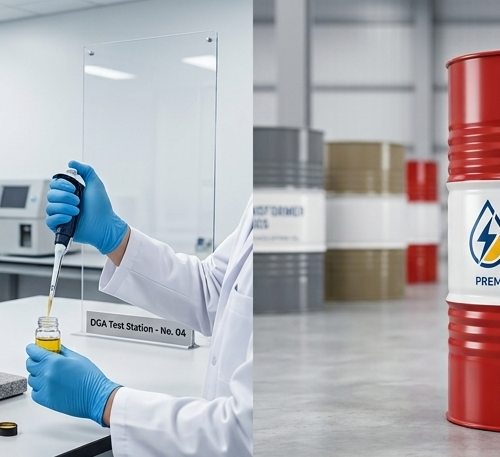
  • The dissolved gas analysis is a powerful tool that helps detect the type of fault in the transformer by determining the type and amount of gases that have been dissolved in the oil due to thermal or electrical stresses. This test is considered the gold standard in the field of transformer oil analysis. The gas content in the oil is evaluated using the standard IS 10593 to identify the type of fault that has occurred in the transformer. This test is recommended at least once a year for the critical power transformers or whenever the gas relay of the transformer is tripped. It helps identify the exact nature of the fault without having to shut down the transformer.

Interfacial Tension Test

  • The interfacial tension test determines the molecular attraction of the oil sample with water, which helps determine the amount of polar contaminants present in the oil. This test is recommended as a part of the advanced Transformer Oil Quality Testing to determine the early signs of chemical degradation of the oil before the sludge formation begins. The test is performed as per the IS 6104 standard to estimate the presence of undesirable contaminants in the oil. It is recommended to perform this test when the acid content of the oil starts to increase to dangerous levels. It helps determine the structural integrity of the internal parts of the transformer.

Flash Point Test

  • The flash point test helps determine the lowest temperature at which the vapors of the oil are ignited when exposed to an open flame. A sudden decrease in the flash point of the oil indicates the presence of highly volatile and flammable contaminants in the oil. This test is performed as per the IS 1448 standard to ensure that the flash point of the oil is not dropping due to the presence of contaminants. This test is recommended after electrical faults, high-temperature excursions, or whenever there is a suspicion of cross-contamination of the oil. It helps ensure the safety of the equipment by determining the stability of the oil under high-temperature conditions.

Resistivity Test

  • The resistivity test is a diagnostic test that helps determine the ability of the oil to resist the flow of current when a direct current is applied across two electrodes. The high specific resistance of the oil is required to ensure that the leakage current between the windings does not exceed acceptable limits. The oil resistivity is estimated in the laboratory as per the IS 6103 standard to ensure that the oil is free from conductive contaminants. This test is recommended as a part of the Transformer Oil Testing Services to ensure the purity of the fluid. It is highly sensitive to the presence of any soluble conductive contaminants in the oil, making it an excellent test for estimating the overall cleanliness of the oil.

Tan Delta Test

  • The tan delta test is a sensitive test that helps determine the dielectric dissipation factor of the oil, which is an indication of the amount of power loss in the oil. An increase in the tan delta value indicates the progressive deterioration of the dielectric properties of the oil, which can be due to structural aging, contamination, or the presence of conductive moisture in the oil. The tan delta test is performed as per the IS 6262 standard and is recommended as a part of the Electrical Transformer Oil Testing to detect the early signs of insulation degradation. It helps ascertain the overall power loss in the transformer windings and is an excellent test for determining the maintenance schedule of the asset.

Furan Analysis

  • The furan analysis helps determine the amount of 2-furfural and other byproducts that have been generated due to the thermal degradation of the paper insulation. Since the paper insulation cannot be sampled directly to estimate the degree of polymerization, the furan content in the oil is estimated to determine the health of the solid insulation. This test is performed as per the IS 15668 standard and is recommended for the transformers that are more than 20 years old or are operated under severe overloading conditions. It helps estimate the mechanical strength of the paper insulation and determines the remaining life of the asset.

For every test explain:

  • Purpose
  • Importance
  • When it should be performed
  • Benefits
title icon

Why Transformer Oil Testing is Critical for Power System Reliability

The implementation of guesswork in the context of high-voltage equipment can be extremely dangerous and expensive. The best way to avoid such problems is to follow industry-standard Transformer Oil Testing Services and keep the transformer stable and secure.

IS 335:2018 (New insulating oils – Specification): This is the standard which prescribes the chemical, physical and electrical requirements which the oil supplied by manufacturers or suppliers should meet before being used in a transformer. It is the latest edition which has been developed with greater conformity to the international standard IEC 60296.

IS 1866:2017 (Mineral insulating oil in electrical equipment – Supervision and maintenance): This is the standard which covers the requirements on the supervision and maintenance of mineral oil used in transformers. It is mainly applied when the oil is already in use by an organization. The standard states the recommended frequencies for the tests on the used insulating oil as well as the permissible limits of parameters of oil subjected to aging and the conditions under which it should be reclaimed.

Prevent Transformer Explosions and Failures: Transformer oil analysis helps detect hidden flaws in the early stages and prevent expensive failures.
Monitor the Condition of Insulation and Liquid Dielectrics: Keeping an eye on the properties of working oil allows assessing the state of both liquid and solid insulation and detecting any chemical changes.

fault levle calculations

Prevent Fires, Arcing, and Flashover: Transformer oil testing helps reduce the risk of electrical fires and associated hazards like flashover and arc fault by ensuring that the oil is able to withstand the test of time and extreme conditions.
Transformer Life Cycle Extension: The early detection of potential issues and the timely removal of defective transformer oil allows for the extension of equipment life cycles through additional maintenance and processing.
Lower Maintenance and Replacement Costs: The treatment of minor oil inconsistencies is much less expensive than rewinding the stator or purchasing new equipment.
Compliance with Legal Norms and Insurance Requirement: Transformer oil analysis keeps the facility in line with national electricity safety regulations as well as the requirements of the insurance company.

title icon

Why Choose Karytron for Transformer Oil Testing

Audits by Karytron

Karytron is a transformer oil testing company in India providing value-based testing solutions through informative test results that help businesses make well-informed decisions. We take pride in our technical expertise and excellent customer service.

  • Government Approved
    We process oil samples through NABL accredited testing labs following Indian
    government standards (IS 335:2018 for new oil and IS 1866:2017 for used oil).
  • Experienced Engineers
    Our team of highly qualified electrical engineers ensures a comprehensive
    understanding of oil chemistry and accurate analysis.
  • Superb Infrastructure
    We utilize contemporary testing equipment that ensures reliable results and
    eliminates the possibility of errors.
  • On-Site Sample Pickup
    Our engineers can be dispatched to your location to ensure sample collection
    using a closed-system sterile methodology, eliminating the risk of contamination.
  • Quick and Informative Reports
    You will receive quick and informative reports delivered directly to your email.
  • Action Plan
    Along with the test results, you will receive detailed guidelines on the necessary
    actions for maintaining your equipment.
  • PAN India Presence and Competitive Pricing
    We offer our transformer oil testing services across India (PAN INDIA) at
    extremely competitive prices.
title icon

Our Transformer Oil Testing Process

Our systematic approach to Electrical Transformer Oil Testing ensures that every sample is handled with total care and precision.

  1. Site Inspection

    Our engineering team checks the physical environment, records the transformer’s operating parameters, and inspects the unit for external leaks.

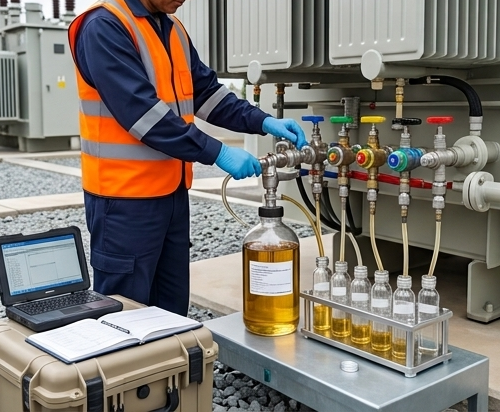
  2. Safe Oil Sample Collection

    We draw oil samples using specialized, completely airtight syringes or bottles to prevent ambient moisture or dirt from contaminating the sample.

  3. Laboratory Testing

    The extracted samples are safely transported to the laboratory, where they undergo comprehensive physical, chemical, and electrical testing.

  4. Result Analysis

    Senior diagnostic experts evaluate the laboratory findings against standardized international benchmarks to identify any deviations.

  5. Detailed Test Report

    We generate an easy-to-read engineering report mapping out the exact condition of your insulating medium.

  6. Expert Recommendations

    Along with your report, we provide clear and practical advice on whether you need to filter, reclaim, or replace the transformer oil.

title icon

Industries We Serve

Our specialized Transformer Oil Testing Services are used across various industries where reliable transformer performance and uninterrupted power supply are critical.

Power Plants

  • Our experts support critical power generation infrastructure by ensuring transformer health and helping maintain uninterrupted electricity generation.

Manufacturing Industries

  • Oil testing services help manufacturing industries prevent equipment failures, reduce downtime, and maintain reliable operations during voltage fluctuations.

Commercial Buildings

  • Our technicians help ensure the continuous functioning of high-rise buildings, business centers, and commercial facilities through effective transformer monitoring.

Hospitals

  • Hospitals rely on our services to protect critical medical equipment and backup power systems that require uninterrupted electrical supply.

Data Centers

  • Data center operators use our transformer oil testing solutions to prevent failures and maintain continuous operation without interruption.

Cement Plants

  • Cement plants depend on reliable transformer performance to support heavy-duty machinery and continuous industrial production.

Steel Plants

  • Steel industries use our testing services to protect high-voltage equipment, including arc furnaces and mills, ensuring smooth industrial operations.

Oil & Gas

  • Oil refining and extraction facilities rely on our expert inspections to maintain uninterrupted operations and maximize production efficiency.

Renewable Energy

  • Wind power plants and photovoltaic facilities utilize our transformer oil testing services to maintain reliable and continuous energy infrastructure performance.

Government Facilities

  • Government facilities use our maintenance and testing services to ensure the uninterrupted operation of defense, transport infrastructure, and other critical assets.
title icon

Benefits of Choosing Professional Transformer Oil Testing

Collaborating with a professional Transformer Oil Testing Company provides several advantages to your business by improving equipment reliability, safety, and operational efficiency.

Our diagnostic procedures identify developing faults at an early stage, such as low-level tracking, arcing, and hotspots, long before they can be physically detected. This helps you avoid unexpected downtime by addressing oil-related issues
during planned shutdowns instead of facing sudden failures.

Regular transformer oil testing contributes to the longevity of your equipment by preventing premature aging and reducing the need for early transformer replacement.

Maintaining proper oil condition reduces stress on transformer components such as pumps, radiators, and gaskets, resulting in fewer maintenance requirements and improved operational reliability.

The process also improves energy efficiency by enhancing heat dissipation and reducing overall transformer losses, especially during load operations.

Professional testing strengthens electrical safety by minimizing the risk of catastrophic failures, structural damage, and localized combustion.

You can also maintain a reliable audit trail that complies with industry standards, making insurance renewals and third-party safety audits smoother and more efficient.

Highlight Outcomes:

title icon

Frequently Asked Questions

What is transformer oil testing?

This is a routine and diagnostic test performed on a regular basis that includes sampling of the insulating oil from the equipment and subsequent analysis of its physicochemical and electrical properties.

How often should transformer oil be tested?

For distribution transformers used in low-power range, a basic Electrical Transformer Oil Testing is advisable once a year. If we are talking about critical power grid transformers, then transformer oil analysis must be performed twice a year.

What is a good BDV value?

Transformers in the voltage class up to 72,5 kV require a BDV value of more than 40 kV. At the same time, for ultra-high voltage equipment, this value is significantly higher.

What causes transformer oil to deteriorate?

High operating temperatures, ingress of moisture, current surges, and chemical oxidation are the main reasons for its degradation.

Why is DGA testing important?

This analysis helps detect minor inconsistencies (partial discharges, local overheating of the insulation) that may not be apparent during a visual inspection. This is especially important in order to prevent serious equipment failures.

How long does testing take?

Each oil test procedure takes 3-5 working days after the sample has been delivered to the laboratory.

Which standards are followed?

We use the most reliable national and international standards (IS, IEC). We often perform a complete set of diagnostics with Oil Testing as the Transformer Main Tank with OCTC per IS: 1866 (Nine Parameters).

How much oil is required for testing?

To perform a complete set of physicochemical and electrical tests, 1-2 liters of oil are needed, which must be taken into a brand new clean, dry container.

Can testing be done on-site?

It is possible to test transformer oil on-site, for example, for BDV, however, for a complete picture, one also needs DGA and Furan tests, which are performed exclusively in a certified laboratory.

How can I book transformer oil testing with Karytron?

To arrange a technical visit for sample collection, you can contact our service desk through the application form on our website or by email.

Call Now Button